Indicator · 6-month horizon
Bitcoin Strategic Bias
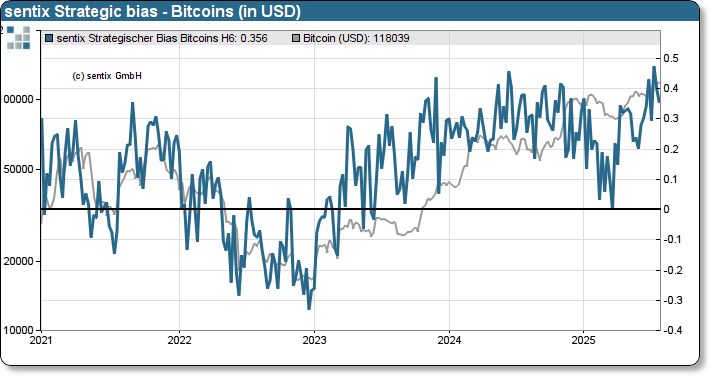
Do investors believe in Bitcoin's value? The Strategic Bias captures their six-month conviction – the wisdom of the many.
WeeklySince 2017Directional · leading
Updated weekly by sentix.
In the same weekly survey, investors also state their expectations for the next six months. The one-month question (the Sentiment) acts as a filter for emotions – so the Strategic Bias reflects investors' basic convictions and their perception of value.
It moves much more smoothly than the Sentiment, tends to form longer trends and usually leads the market. Unlike the Sentiment, it is therefore read as a directional indicator – not against the crowd.
Because it bundles the knowledge scattered among many different market participants, the Strategic Bias is shaped by the “wisdom of the many”.
| Reading | What it often means |
|---|---|
| Rising trend | Growing conviction. Investors become more willing to buy – often ahead of rising prices. |
| Falling trend | Eroding conviction. A growing willingness to sell, often before prices weaken. |
| Divergence to price | Conviction and price move apart for a longer period. As the bias tends to lead, this can open up opportunities. |
| High bias, low Sentiment | Strong conviction meets short-term fear – historically often a particularly good entry point (and vice versa). |
Best used in combination. The Strategic Bias shows the direction, but it should not be the only basis for entry or exit decisions.
Ideally, the short-term Sentiment moves against the Strategic Bias: a high bias combined with a low Sentiment is a classic entry setup. The Time Differential turns this relationship into one number.
More on the methodology: sentix indicator compendium
What does the current reading mean? The sentix Bitcoin report explains it – free, every Sunday.
Subscribe for free